Sunday, February 3, 2013

The origin of Kalash


The origin of Kalash

By Mohammad Qasim Baig
Chitral is known throughout the world for its rich cultural heritage and scenic beauty. It is located in the northwestern part of the NWFP, between 71* 12 and 73* 53 east longitude and between 35* 13 and 368* 55 north latitude. It is bounded in the North West by Badakhshan and in the South-West by Noristan province of Afghanistan; Dir and Swat districts of Pakistan are located on the south of the valley while the Northern Areas of Pakistan (Ghizer, Goopis, Hunza and Gilgit etc) are the neighbors on the east of valley. It was a princely state up to 1969, when it was formerly merged in to Pakistan as a district of the Province Khyber Pakhtun Khuwa (K.P.K). Though the Chitrali culture itself is very rich and attractive but the culture of a small group of people within the district, named the Kalash culture is more attractive for the people from the world.
Total population of the Kalash people is 2,500 to 3,000 and they live at an altitude of 2,000m to 25,00m, in three small villages of the narrow isolated valleys of Chitral district. The Kalash people respect their cultural heritage left to them by their ancestors and they retain a clear memory of their rich heredity, traditions, language, stories, songs, dances, rituals and a number of festivals, which they still keep.
Origin of the kalash people is uncertain. The most common theory about their origin is that they are the descendents of Alexander the Great, when he (Alexander) passed through this region in 327 B.C., some of his soldiers settled here so probably Kalash people are the ruminants of the Greece army. But Archaeologist Prof. (Dr.) Ihsan Ali,
Vice Chancellor Abdul Wail Khan University Mardan and the Ex-Director of Archaeology and Museums Government of Khyber Pakhtun Khwa are against this theory and he is of the view that Kalash are indigenous people of this area and they (Kalash) are most probably descendants of the Aryans because neither Alexander nor his forces have touched this particular valley Chitral. To prove this theory and to trace the origin of the Kalash people Dr. Ihsan Ali and his team have conducted excavations of the Gandharan graves, in upper and central Chitral district. Human remains unearthed during the various excavations conducted in the area are in the process of examination by the DNA and radio carbon dating experts from international institutions like Leicester University UK and California University Bakersfield USA.Seven samples of human bones collected during the excavations were submitted in 2007 to the University of Waikato Radiocarbon Dating Laboratory, Hamilton, New Zealand. These included six samples of inhumed bone from Singoor and Parwak Villages and a single sample of cremated bone from a cist grave at Gankoreneotek near chitral air port.
Excavation of aburial site at Gankorinio Tek, Singore Chitral.
Period of the age of remains from Gankoreneotek, Singoor and Parwak range from 1000 BC to AD 1000. On the basis of these dating results and the large number of ancient graves found in the area, having similarities with the burial style of the kalash people are the facts which support the theory of the Great Archaeologist of the Country, Prof.Dr.Ihsan Ali. Beside, collection of “Dental Casts” to find out the origin of different ethnic groups including the Kalash people is in-progress, led by Prof.Dr. Brian Hemphill of California University Bakers Field USA. Prof. Dr. Brian Hemphill and his team visited almost all the areas (valleys) of the Chital district in August, 2005 and collected samples from different ethnic groups. Samples from the ancient cemeteries located in the Kalash valley were also collected in order to continue the research work on the origin of the Kalash people.
Dr. Brian and his team collecting dental Casts from the kalash People.
Though, because of the efforts and support of Prof. (Dr.) Ihsan Ali, research work in shape of explorations, excavations and dental casting by national and international institutions has been done in the past but more research work in this context is direly needed in order to find out exact profile of the Unique Kalash people.

Sunday, September 23, 2012

Kalash Valley: Paradise lost


Kalash Valley: Paradise lost
By Maureen Lines | From InpaperMagzine | 26th August, 2012
Thirty-two years ago, I was enchanted by the poetic and sublime beauty of Bumburet, one of the Kalash Valleys. There were indeed meadows with sparkling water from the irrigation channels, fed by the rushing foaming river. Willow trees stood on the river bank and giant walnut trees shaded the bright green grass. The mountains stood in the back, while up river, the snow clad top of the Shawal Pass gleamed in the bright sunlight.
Now my favourite meadow is no more. On that site is the PTDC hotel, which I and the people fought to stop from being built, but to no avail. That was some years back. Since then, cement built hotels have proliferated, as have shops and other out-of-place buildings such as the Greek Kalasha Dur, which would look great in Athens, but in Bumburet stands out like the proverbial sore thumb. Now there is talk of a big hydroelectric power station being built to feed down country. The other valleys have not escaped either.
A few years ago, someone gave money to one of the elders to build a dancing ground on the top of Grom in Rumbur — cement pillars and a metal roof. Kalash and tourists were aghast. Finally, to the relief of all, it was demolished, but what has risen since? Another cement structure, albeit not so big and with a painted metal roof. Now Grom cannot be the heart of any World Heritage Site. Other cement structures have also been erected in Rumbur. This trend started with Bashali Houses being built, helped by the local administration.
Birir has not escaped either in spite of the pressure I put, backed by some erstwhile bureaucrats.
The Autumn Festival, known locally as Pur, was ruined forever by a Secretary of Minorites (he had never visited the valleys) who sent funds through the usual channel of local administration, which then reportedly gave the money to C&W (construction and works) for retaining walls and the rest was then handed over to a contractor, known to everyone as a timber merchant; unless someone declares it illegal and orders it to be pulled down, the high cement wall, cordoning off the dancing area and the small jestakhan (Kalash temple), has shut out forever the beauty of the valley to the dancers and tourists. What was once a joyful festival has now been corrupted. I have never returned to see the Pur. Again, who is going to remove the broken down cement from the river?
A couple of years ago, thanks to Minoo Bhandara, whom the people had asked to rebuild the jeep track on the other side of the river, money was again given through the same channel and yet another timber merchant appointed as contractor. To the surprise of many the bridge collapsed even before completion. The shipment of wood constantly puts pressure on both the cement pillars and the wooden planks upon which these heavily laden vehicles have to cross. The historical Gahiret Bridge suffers the same fate. The bridge has been repaired twice now by a brave and fearless engineer.
This year, to my horror, I got to know that the steps we built for the people of Guru have been replaced by a dangerous cement staircase, the base of which is one long slope. Covered in winter ice it will be a public danger to the inhabitants. It will also rule out Guru Village being thought of as the heart of the world heritage site.
Likewise, a project encompassing four cement latrines has been undertaken near the Bashali House of Bishal (though only a few women go there), which we built only a few years ago, complete with a washroom and commode. Near the Bashali we built near Guru, which is checked constantly by one of our Kalash women health workers, more latrines have been built — puka ones with tiled walls and floors. There is also a special room for washing hands.
When the population, both Kalash and Muslim, are in need of retaining walls, bridges and irrigation channels on a priority basis, this senseless waste of money is unforgivable. Again, it will not help our long pursuit of making the whole area a Unesco Biosphere and certain villages a world heritage site.
About five years ago, when Ingeborg Breines was the representative for Unesco, I went to Geneva and Paris to discuss the possibility of the Kalash Valleys becoming a WHS. I was told that as the region in question (including Jingeret Ku, where there are the remains of two Kalash Defence Towers, which we restored with Finnish money) was spread over a large area, a Biosphere with a special site as the core of the WHS would be in order.
On my return to Pakistan, I met with a number of officials in Islamabad. Mostly I was paid lip service, but then last year, the current Chief Secretary, Ghulam Dastgir, and the former Secretary of Culture, Azam Khan (now Home Secretary), took up the idea and the Culture Secretary wrote a proposal to go along with the WHS forms. It was then passed on to the Secretary of Minorities (now transferred) to deal with, and then also given to Faridullah Khan, the federal secretary of heritage, who was also transferred. Except for an offshoot seminar in Islamabad earlier this year, nothing more has been heard of the matter.
It is hoped that the new secretary of minorities will take an interest and push the proposal to meet the end of September deadline; otherwise, we shall have to wait another year, before we can again apply. A while back, our NGO attended a government meeting with C&W. The Line department listened to us and have agreed to find ways of removing the concrete from the steps and the broken cement retaining walls from the river. Who knows how things will proceed, but at least hope burns eternal.

Tuesday, July 3, 2012

Linguistic Diversity in NWFP


The NWFP has always been in limelight, but for wrong reasons. From the British raj’s Afghan wars in eighteenth century to Russian invasion in 1979 and American ouster of Taliban from Kabul in 2002, NWFP had been pivotal to the imperialistic designs, as it provides road access to Afghanistan. Later, the emergence of local Taliban and militancy, itself a product of 30 years long Afghan war, put the Frontier on the map of world, as the bastion of terrorism.
The media stereotyping put the beautiful aspects of its culture, history and people on the backburner and nowadays world knows the people of the Frontier as mere suicide bombers and terrorists. However, there are many a remarkable traits and cultural aspects, which only the Frontier could claim and linguistic diversity of the province is one of such traits.
There are around 69 languages are spoken in Pakistan, 26 out of these spoken in NWFP, and 12 languages in Chitral district alone. According to Frontier Language Institute (FLI) Bateri (20,000), Chillaso (2,000), Gowro (200) and Kohistani (200,000) are spoken in Indus Kohistan.
Chitral district, according to renowned Norwegian linguistic Georg Morgenstierne, was the area with the highest linguistic diversity in the world. The languages give the district a unique flavor of socio-cultural richness and ethno-linguistic diversity. Dameli (2,000), Gawar-Bati (200), Kalasha (3,000), Khowar (200,000), Palula (2,000), Wakhi (2,000), Yidgha (2,000) and Kam-Kataviri (2,000) are the languages spoken in district.
Kalasha is the mother tongue of the famed and mysterious race of Kalasha living in the valleys of Rambur, Bomboret and Berir, while Kam-Kataviri is of the Nuristani people. Nuristanis are the people believed to be subject of a Kipling story “The Man Who Would Be King” which was adapted as motion picture starring Sean Connery in 1975. Unlike Kalasha who are known as the black Kafirs (infidels) due to the black outfit they wear; Nuristanis are known as Red Kafirs due to the red color of their skin.
While, Domakki (200) Hunza, Shina (200,000) Gilgit, Balti (200,000) Baltistan, Burushaski (20,000) Hunza, Nagar and Yasin, Kashmiri, Kundal Shahi and Pahari-Potwari are spoken in Northern Areas and Azad Kashmir.
Gwari (20,000) is spoken in Swat and Upper Dir, while Torwali (20,000) and Ushojo (200) are spoken in Swat, while Kalkoti (2,000) is spoken in Dir Kohistan and Ormuri (2,000) is spoken in South Waziristan.
Pashto and Gojari are spoken throughout the region and Hindko is spoken in Peshawar, Kohat and Kashmir. However, as most of these languages are spoken by small communities, therefore, qualify for categories of languages near extinction and threatened languages and it is need of the hour to preserve this marvelous part of our ethno-linguistic heritage.
* Number within brackets shows number of speakers in excess of the number.

Tuesday, May 22, 2012

Why won’t NADRA recognise the Kalasha?

Why won’t NADRA recognise the Kalasha?
May 10, 2012

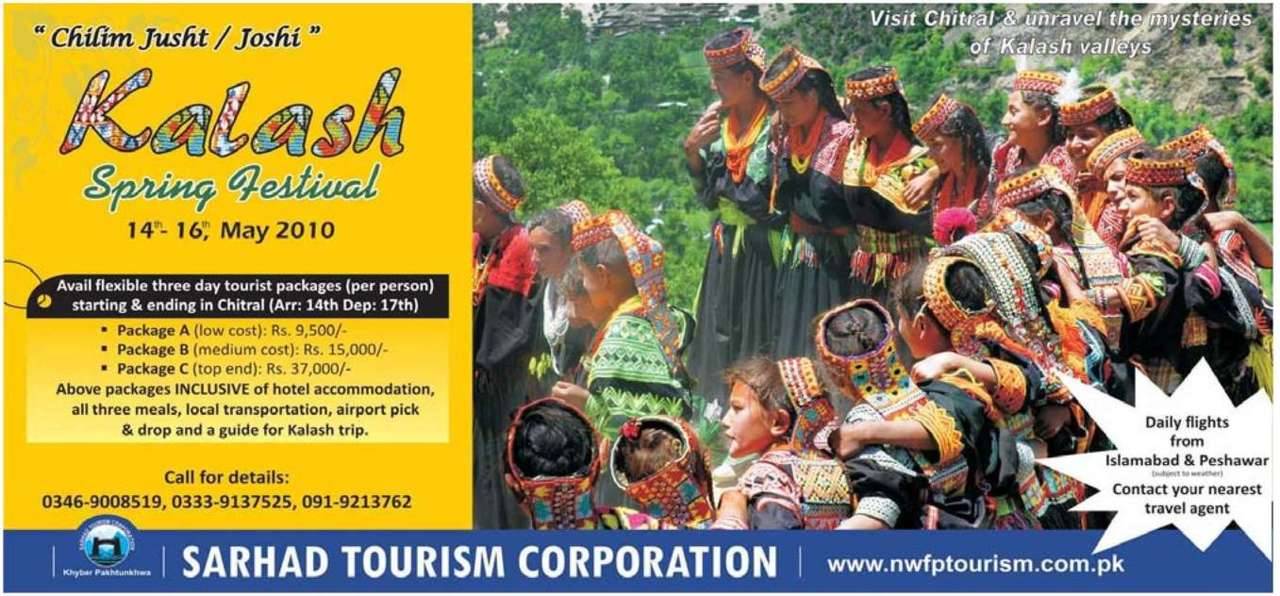
The Kalasha women wear a traditional outfit and neck beads as a hallmark of their Kalasha religion and they don’t cover their faces. PHOTO: SIKANDAR
Did you know that there is a pre-historic animist religion called Kalasha –  a religion still practised and cherished by the Kalasha people of the Hindu Kush valley?
Are you also aware that the Kalasha people don’t even have an option to choose their religion in the ‘religion box’ endorsed by the National Database and Registration Authority (NADRA)?
Nadra came under scrutiny when it refused to rectify typographical errors it had made of a Christian MPA Rana Mahmood that identified him as a Muslim on his national identity card.
The issue drew a considerable amount of attention from both the media and human rights activists, who criticised Nadra for various violations of fundamental rights. Following the criticism, Nadra issued an official statement apologising for the error made. The statement reads:
[A] High level inquiry was ordered by the authority to investigate the matter as to why such inconvenience was caused to our honourable MPA… [I]t was revealed that a Nadra data entry operator had mistakenly put his religion down as Islam because of his Muslim-sounding name.
The Kalasha community has been a victim of this human rights contravention by Nadra since the day the ‘religion box’ was introduced by General Ziaul Haq in the 1980s and the ‘Kalasha religion’ was not included in the list of religions.
An old Kalasha elder confides that,
We didn’t have any option to have our religion on our identity cards like everyone else, even though our religion is the oldest of all, so we brought the matter to the attention of MP Bhandara (MNA elect for minorities), when he visited the Kalasha Valleys. He made an effort to convince the authorities to include the Kalasha religion in the list of religions but they didn’t register Kalasha instead they included ‘others’ in the list of religion as an option.
When the computerised national identity cards (CNIC) were introduced, the Kalasha religion appeared in the list of religions for a short while before Nadra removed it again. (One is led to ask who exactly instigated this removal and why?)
The Kalasha tribe has repeatedly protested, demanding recognition for their religion – an acknowledgement which is their constitutional right to have but the authorities have shown no interest, constantly ignoring their plea to the point of even sidelining a recommendation from the Ministry of Minorities Affairs to include the Kalasha religion in the list of religions.
The outcome of this ignorance and negligence, due omission, is that it paves a way for systematic discrimination.
For example, in Chitral, Nadra officials have repeatedly insisted that the Kalasha women cover their dresses with a scarf while taking photos for their national ID cards. The Kalasha women wear a traditional outfit and neck beads as a hallmark of their Kalasha religion and they don’t cover their faces.
On the one hand, the Kalasha people are deprived of their rights to maintain their identity, culture, religion and language as per the constitution, while on the other hand the tourism ministry exploits them, making every effort to feature the Kalasha women in posters and commercial marketing, using them as advertising assets as the ‘Mystery of the Kalash’ on their brochures and billboards.
And yet they have no right to be acknowledged or accepted as a separate religion.
With all this flamboyant advertising, where is the sense in asking them to cover their traditional neck beads with a scarf in the ID card profile photo?
Can Nadra’s motives be questioned in this case?
Does it mean that Nadra is on a mission to assimilate every diverse cultural aspect of the people of Pakistan?
Nadra seems to have claimed the right to decide people’s faith, depriving Pakistani citizens from acknowledging their respective faiths; tarnishing their rich cultural and religious heritage. In fact, the whole idea of declaring religion in official documents is absurd, since religion is regarded as a personal matter.
Having to declare religion for official use should be treated as a violation of our basic primary rights.  It may lead to discrimination in official as well as daily affairs.
If, however, declaration of your religious belief is still a prerequisite, then it is high time Nadra revises its discriminatory policy towards other religions and either amends the list it has at the moment to does away with it altogether.
They have to accept the fact that Kalasha is a separate religion, and they have to concede to the religious diversity in Pakistan so that every Pakistani, whether Muslim or non-Muslim can be confident that they are equal before the law regardless of their religious or spiritual beliefs.
The mistreatment of the Kalasha people in Pakistan has been very well observed, noticed and pointed out by Ms Nosheen Abbas, a BBC journalist, who calls to attention a very important fact about the complex situation they face. She says,
Pakistanis would view Kalash culture with disapproval but nevertheless many, mostly men, still flock to the valleys from around the country to experience the liberation the festival offers.
The Kalash use the blanket term “Punjabi” for the Pakistani men who suddenly show up in the village staring at women, trying to “chat them up”, and making many feel uncomfortable. They do not consider themselves Pakistani. In fact, they call anybody from elsewhere in the country “Pakistani” – as if that term would not cover themselves as well.
The Kalasha tribe, like every other minority group, deserves what the constitution provides for them; the basic right of recognition and acknowledgement.


Wednesday, April 11, 2012

Battle of survival: Watching the tongues slip into extinction


A classic case of irony.
While lawmakers table ‘ethno-linguistic’ basis for the creation of new provinces; in hindsight, the debate renders itself preposterous given the fact that 28 of the languages across the country are dying out.
Preservation seems to be one item missing from the to-do lists of lawmakers.
Khyber-Pakhtunkhwa (K-P) and other northern areas of the country are host to about half of languages spoken in Pakistan — a significant majority of which have been listed as ‘endangered’.
The United Nation Educational, Scientific and Cultural Organisation (UNESCO) Atlas of the World Languages in Danger documents around 28 Pakistani languages as endangered in various categories. The UNESCO Atlas lists six of these languages as ‘severely endangered’, 15 as ‘definitely endangered’ and seven as ‘vulnerable’.
Dying out
According to the UNESCO report, among the languages Pakistan could potentially lose are: Khowar spoken in Chitral and parts of Gilgit with an estimated number of 220,000 speakers left; Burushaski spoken in Nagar Hunza which has 87,000 speakers left; Maiya in Indus Kohistan with 220,000 speakers left; Purik is mainly spoken in Kashmir; however, data regarding the exact number of speakers is not available.
Furthermore, Bashkarik is majorly spoken in Swat and Dir by around 40,000 people, Bateri on the east bank of Indus Kohistan with 29,000 speakers, Bhadarvi along the Line of Control in Kashmir with 66,198 speakers, Gawar Bati in Chitral with 9,500 speakers, Kati in Nuristan and Chitral by 18,700 people, Kundal Shahi in Neelum Valley with just 500 speakers, Orumuri in South Waziristan with a 1,000 speakers, Palula in Chitral with 8,600 speakers, Savi in Chitral and Afghanistan with 3,000 speakers and Torwali in Swat is spoken by around 60,000 people.
Similarly, Chilasso is spoken in Indus Kohistan with around 2,000 speakers left, Dameli in Chitral with 5,000, Domaki in Gilgit with 500, Gowro in Indus Kohistan with around 200, Kalasha in Chitral with 5,000, Kalkoti in Dir Kohistan with around 4,000, Ushuju in Swat with 2,000, Wakhi along Wakhan corridor with 75,000, Yidgah in Chitral with 5,500 and Zangskari whose exact number of speakers are not available.
No preservation
However, Forum for Language Initiative (FLI) Programme Manager Mohammad Zaman Sagar has questioned the authenticity of the figures. Zaman told The Express Tribune that there is a Badeshi dialect in Swat, which is on the verge of extinction, has only two speakers left.
He added that the number of speakers of the Gowro language are stated to be around 40,000, while the total population of Kalam stands at around 70,000.
“Some of these figures are as old as 1970s,” he said.
Zaman believes lack of documentation to be a major hurdle in the preservation of these languages. According to him, only Khowar, Palula and Kalasha have been documented for in Chitral out of more than a dozen languages spoken in the region; only Gowro and Torwali have been documented for in Indus Kohistan and Swat out of around six languages; and only Indus Kohistani and Sheena have been documented for in Indus Kohistan out of as many as six languages.
The FLI programme manger said that even on the national level, proper documentation has only been conducted of around 20 languages.
He said that Yidgha in Lotkuh was under threat of extinction with hardly 1000 speakers left, while Badeshi and Ushuju in Swat, Gowro and Bateri in Indus Kohistan, Domaki in Gilgit and Kundal Shahi in Kashmir were also endangered.
Zaman lamented government apathy towards these languages and said: “We will only be able to express our sorrow, after a language dies down.”
Restive frontiers
Lack of an official body monitoring preservation is not the only obstacle. Militancy in the tribal belt has also created significant stumbling blocks for the preservation of these languages — with Ormuri in South Waziristan as a classic victim.
Unofficial figures state that Ormuri is spoken by around 10,000 peoplein the the Kaniguram area of the South Waziristan — a remote village in Mehsud tribe’s heartland.
“The number of Orumuri speakers is about 10,000,” said Zaman, adding that a majority of locals who used this language have been displaced due to militancy — scattering them across the country.
“Within a community, a language is automatically preserved when you speak it, but when a group is displaced, the chances of that language being abandoned or dying out are much higher,” Zaman said.
Lack of govt support
Fakhruddin Akhundzada, a language activist belonging to Chitral and associated with the FLI, was of the view that the lack of government support was the basic hurdle in preservation of these languages.
“Unlike Urdu, which is language to only six percent of the population, no other language gets any attention from the government,” he said.
He pointed out that there was no law at the federal or provincial level to encourage and preserve these languages except a recent effort by the K-P government to set up a language authority.
However, Akhundzada believes that the advent of social media and the telecommunication revolution maybe be serving as a blessing in disguise for these dying languages.
“Most of these languages do not have any script; however, use of Romanised versions by many people in short messaging service (SMS), chatting and Facebook, have recently risen,” he said.
It seems though, without concerted efforts on the part of the country as a whole, we may very well not hear the sound of these languages again.
Published in The Express Tribune, February 21st, 2012.