Showing posts with label culture. Show all posts

Thursday, May 7, 2015

KALASH – THE VALLEY OF KAFIRS


KALASH – THE VALLEY OF KAFIRS
Προστέθηκε από 24grammata
Minority: Kalash
Country: Pakistan
Author: Rabia Shahid
How would it feel to be part of a culture that is practiced by just 3000 people in a global population of billions? The Kalash culture is indeed unique. Situated in the midst of a Muslim majority population, the three little villages of Kalash are an excellent example of the preservation of a community which is distinct in its ethnicity, language, religion and culture.
The Kalasha community is the smallest minority in the Islamic Republic of Pakistan. The 1973 Constitution of Pakistan under Article 260 only recognizes religious minorities, ignoring the existence of other types of minorities. Kalash is located at a height of 1900 to 2200 meters in the Hindu Kush mountain range between the Afghan border and Chitral valley in the Khyber Pakhtunkhwa Province , Pakistan. It primarily consists of the three villages of Birir, Bumburet and Rumbur, locally known as “Kafristan” (land of the infidels, coming from the word Kafir which is an Islamic term for an unbeliever). The valleys are situated to the southwest of the town Chitral at a distance of 40, 43 and 36 kilometers respectively.
Historically, Kafristan included the region of present day Nuristan in Afghanistan and the three Kalash valleys. It is believed that in 1320 the population of the Kafirs was 200,000. This has now reduced to a mere three to four thousand. In 1895, Amir Abdul Rahman, the King of Afghanistan, conquered the Afghan region of Kafristan and forced the Kafirs to convert to Islam. It was at that time that the Afghan Kafirs migrated to the Chitral valley to avoid threats of conversion. The people of Chitral gave them a warm welcome, allowing the community to exist and practice their religion and culture without any restraint. According to Israr-ud-Din (1969), the Kalash ruled Southern Chitral for around three hundred years, until they were overtaken by the Khowar speakers. Thereafter, some Kalash retreated to the valleys they occupy today and some became Khowar speakers and converted to Islam. The cordial relationship between the Chitralis and the Kalash people who refused to come under the religious and political influence of the Khowars exist today, even though radical Islamization of the country has posed some challenges for them. As per Kalash custom, once a person converts to Islam he or she is banished from the community and cannot revert. Today the number of Kalasha speaking converts living in the vicinity of the valleys exceeds the number of the original polytheistic Kalasha.
Origin of the Kalash community in Pak-Afghan region
The historic origins of this community are shrouded in mystery and controversy. Different theories exist as to the origin of the Kalash people, the most popular and grand being that they are descendants of Alexander the Great. The other two theories propose that they are an indigenous population of South Asia, or as suggested in Kalash folk songs and epics that their ancestors migrated to Afghanistan from “Tsiyam”, which is identified by some anthropologists as the area of Tibet and Ladakh.
There are many pieces of evidence presented by all schools of thought in this matter, making it difficult to trace the true origin of this minority. The Greek influence is found in the architecture, music, games, food, wine, and even in the blond hair and blue eyes of the Kalash. Yet at the same time certain genetic studies, like the study by Rosenberg, have come to the conclusion that this race is a separate aboriginal population with little influence from outsiders. Another genetic study “Worldwide Human Relationships Inferred from Genome-Wide Patterns of Variation (2008)” also came to a similar conclusion and categorized the Kalasha population as a separate group of people.
The Kalash Language – no written documentation
Kalash is a Dardic language which belongs to the Indo Aryan Group of the Indo-Iranian group of languages, which is itself a sub group of the larger Indo-European Group. Kalash is further categorized into the Chitral sub-group of languages, next to only one other language, Khowar. Though the two languages are different, they nonetheless share some similarities, and due to the increased interaction between the native speakers of these two languages there are now more bilingual people speaking both Khowar and Kalash as there were in the past.
The most distinct characteristic of the Kalash language, along with some other local languages of the Chitral District, is that it is purely oral and has no written manuscript. Thus all the folklore, customs and traditions have been handed down from generation to generation through word of mouth without any written documentation. Absence of a written manuscript, coupled with the fact that around four thousand people speak this language, has placed it on UNESCO’s list of critically endangered languages.
However, the people of Kalash maintain great pride in their language and the usage of this language has not decreased in the Kalash valleys over the passage of time. It is normal to see Kalash people interacting in their language in their homes, streets and markets. The most popular second language with the Kalash people is Khowar, but it is only used by people who go outside the Kalash valley for business or work, thus women and children are in a majority of the cases monolingual.
Recently many attempts have been made by local Kalash people in cooperation with foreign NGO’s to preserve the Kalash language via its documentation. In 2000, Taj Khan Kalash, a local Kalashi, organized the first Kalash Orthography Conference in Islamabad. Working in collaboration with international linguists and researchers, the first alphabet book of Kalash language in Roman script was published. Efforts are now being made to teach the Kalash people how to adjust to this evolutionary change in their language and learn how to write it. Significant research has taken place in the codification of this language; the dictionary of the codified Kalash language is even available online today, increasing the possibility for linguists and researchers to study this language in more detail.
Despite efforts to preserve the language, the community faces tough challenges in preserving it for future generations. It was in 1989 that the government allowed the Kalash to use their language as the medium of instruction, despite the uniform syllabus rule in the country. The majority of the teachers are Khowar native speakers, resulting in the instruction language to be Khowar rather than Kalasha. Thus, the major logistic hurdle in the teaching and preservation of the language is a lack of schools teaching the Kalash language and using it as a medium of instruction.
Kalash Culture: Festivals and Purity
The Kalash culture has been the centre of fascination for tourists, the British, and many anthropologists for years. Compared to the conservative Islamic majority, the Kalash valley, which is well protected within the mountains of Hindu Kush, is the home of polytheists for whom dance, wine and mingling between the sexes is not a taboo.
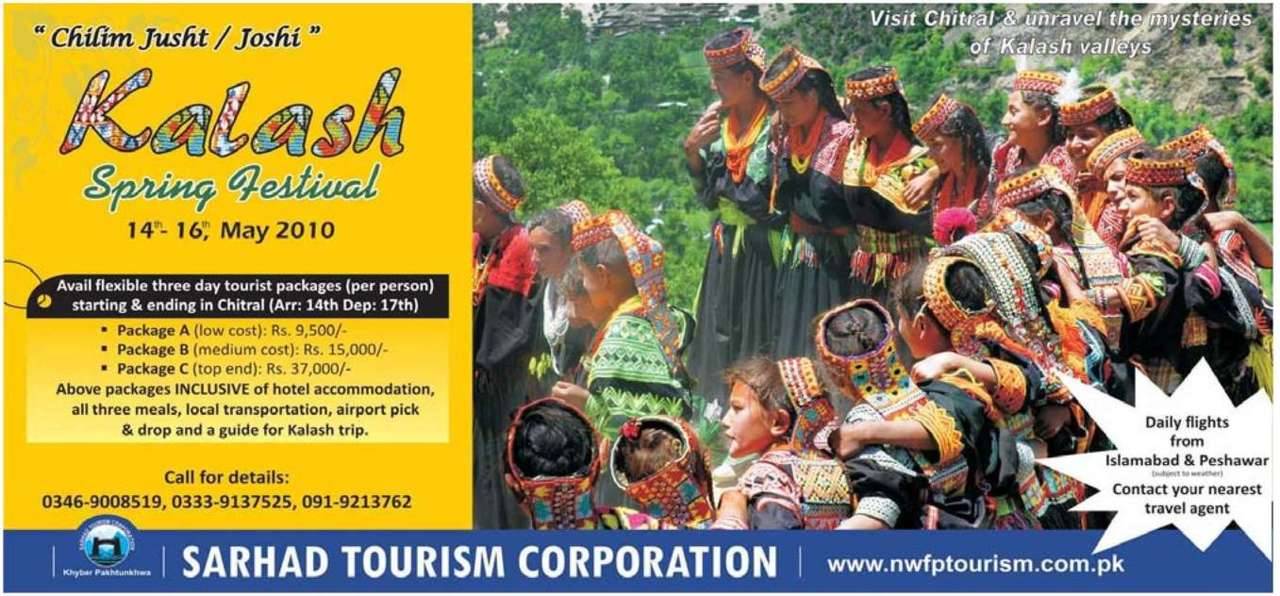
Nature plays a spiritual role in the lives of the Kalash people and this is reflected in the gods they worship and the customary festivals of the community. Among many festivals celebrated, the three main ones are the Joshi festival celebrated in May, the Uchau festival celebrated in autumn, and the most important Chaumos festival celebrated for two weeks at the winter solstice. Festivals are a way to offer thanks to the gods for the abundant natural resources gifted to the people of the valley. The Kalash people like to celebrate, and a typical festival involves singing, dancing, offering bread, cheese, meat or wine, and at times a sacrifice. The women of the community take active part in the singing and dancing at the festivals. Unlike Muslim societies, there is no concept of segregation in the Kalash society. Men and women freely interact with each other. Women are free to choose their husbands, while sex and love affairs are a common occurrence.
Kalash women are easily distinguishable due to their unique dress. They always wear a long black gown stretching on until their ankles. The gown is adorned with colorful beads and cowrie shells and accessorized by bead necklaces coiled around the neck, accompanied by an ornamental headdress. Men wear the traditional national dress of Pakistan with a woolen waistcoat.
The Kalash culture is very particular about the pure and impure. A particularly intriguing tradition is the tradition of Bashli. Bashli is the tradition of sending menstruating women and the ones giving birth to a special home. They can only come out of the home after the menstrual or child birth period is over. During such a state a woman is considered impure. Gods are considered pure, and between impure women and pure gods there are degrees of pure entities. A man is considered more pure than a woman, and an innocent boy would be more pure than an adult. There are also designated pure areas inside houses where women cannot go because they are considered impure.
Discrimination and attempts to convert to Islam
Kalash is a pastoral community which is heavily dependent upon agriculture and livestock. Over the years tourism has also become a major source of income for the Kalash people. However, generally the area remains underdeveloped due to its remote location and also because of the apathy of the authorities. The Kalash people are poor and face discrimination when it comes to jobs. Money that comes in from tourism seldom comes in the hands of Kalash people as majority of the hotels in the vicinity are owned by non-Kalash.
Availability of cheaper alternatives, coupled with poverty, is endangering the use and production of rich Kalash gowns worn by women, and of certain foods and drinks, especially the production of wine, which is often expensive. Infrastructure is weak as there are not enough roads, hospitals, high schools and universities for the Kalash. This forces many families to convert to Islam; a trend which is detrimental to the existence of the Kalash. The religious sites of worship are also in danger due to attacks by Islamic fundamentalists and a lack of funds for maintenance.
Lack of media causes discrimination
The discrimination is allowed to continue due to the absence of any medium of communication that would connect the Kalash communities with the outside world. There are no Kalasha newspapers, radio or TV stations. Other than a few websites personally made by some Kalash individuals, there is no official presence of the Kalash community in the media in the form of a group or organization. Any development in the area of preservation of the valley and its culture has primarily come from the Ministry of Culture and Tourism and international aid groups interested in the region. Major aid and development is devoted to improving and facilitating cultural festivals, tourist information and environmental protection measures. According to Saifullah Jan, an activist who has represented the Kalash people at many forums, more resources need to be devoted to basic infrastructure like schools, roads, and health facilities to ensure the survival of these indigenous people. Also, less interference should be made into matters of farming and irrigation techniques, which according to him are something that the people are already well versed in.
Bibliography:
1. SOCIOLINGUISTIC SURVEY OF NORTHERN PAKISTAN VOLUME 5 LANGUAGES OF CHITRAL. Kendall D. Decker 1992. National Institute of Pakistani Studies Quaid-i-Azam University and Summer Institute of Linguistics.
2. The Kalash – Protection and Conservation of an Endangered Minority in the Hindukush Mountain Belt of Chitral, Northern Pakistan. IUCN – The World Conservation Union.
3. Minority Rights Group International, Report on Religious Minorities in Pakistan, by Dr. Iftikhar H. Malik.
4. Enclaved knowledge: Indigent and indignant representations of environmental management and development among the Kalasha of Pakistan. Peter Parkes, University of Kent, Department of Anthropology, United Kingdom 1999
5. THE KALASHA PAKISTAN) WINTER SOLSTICE FESTIVAL. Alberto Cacopardo and Augusto Cacopardo Liceo Scientifico “G. Ulivi” Borgo San Lorenzo. Ethnology, Vol. 28, No. 4 (Oct., 1989), pp. 317-329. University of Pittsburgh- University of Pittsburgh- Of the Commonwealth System of Higher Education.
6. Low Levels of Genetic Divergence across Geographically and Linguistically Diverse Populations from India. Noah A. Rosenberg, Saurabh Mahajan, Catalina Gonzalez-Quevedo, Michael G. B. Blum1, Laura Nino Rosales, Vasiliki Ninis, Parimal Das, Madhuri Hegde, Laura Molinari, Gladys Zapata, James L. Weber, John W. Belmont, Pragna I. Patel.
7. Worldwide Human Relationships Inferred from Genome-Wide Patterns of Variation. Jun Z. Li, Devin M. Absher, Hua Tang, Audrey M. Southwick, Amanda M. Casto, Sohini Ramachandran, Howard M. Cann, Gregory S. Barsh, Marcus Feldman, Luigi L. Cavalli-Sforza, Richard M. Myers.
8. Proceedings of the third International Hindu Kush Cultural Conference – A minority perspective on the history of Chitral: Katore rule in Kalash Tradition, Peter Parkes

Wednesday, February 11, 2015

The Kalash in quarantine

The Kalash in quarantine
Zubair Torwali Saturday, July 05, 2014
From Print Edition
Hardly would there be a gallery in Pakistan where the colourful portraits of the uniquely beautiful Kalash women are not displayed. At every hotel one can see pictures of the Kalash girls in their traditional attire.

The Kalash culture is among the few things Pakistan can boast of as a tourist attraction. The print media carries features on the Kalash, sometimes with some poorly researched description of their traditions, rituals and festivals.

The Kalash are usually termed as very mysterious people. Some researchers trace their history back to Alexander the Great by asserting that they are the descendants of Alexander’s soldiers who were left in the area. However, latest research based on the archaeological findings in Chitral and Swat suggests that the Kalash tribe is the remnant of the Dards – an ancient nation that occupied northern Pakistan, northern Afghanistan and Kashmir.

There is a great similarity of lexicon, syntax and grammar of the Kalasha language with that of the Dardic languages spoken by people in the region. Forced conversion in the wake of invasions by outsiders compelled the Dards to quit their indigenous worldview and shift to Hinduism, Buddhism and later to Islam. There are still many ethnic groups in the region that converted to Islam just three or four centuries ago.

Among these ethnic groups the present Kalash people have still retained their own worldview to some extent. On the one hand they are unique and add to the cultural diversity of Pakistan – and consequently to the tourism industry – while on the other they are the signposts of a lost history.

Owing to their unique traditions and way of life they are presented to the world with apparent pride. But what is missing is care, respect and development by the state.

The first time I visited the valley was in 2007. Almost seven years later I, unfortunately, have seen no improvement in the lives of the Kalash.

The Kalash people, who are now hardly 4,000 in number, are virtually living in fearful quarantine. They are the most disadvantaged members of our society who languish in utter misery, extreme social pressure and fear.

The Kalash Valley borders with north Afghanistan where the Taliban rule. The Taliban recently issued a video threat to the Kalash and other tribes in Chitral asking for complete conversion or get ready for the worst. The Kalash people are too scared to move freely in their mountain pastures where the Taliban slaughtered a Kalash youth and snatched over 1000 sheep.

The Kalash are the soft victims of a certain mindset that is hell bent on targeting the Kalash faith.

The predicament of the Kalash doesn’t end here. They are very resentful of the tourists, particularly Pakistanis, who visit their valley – not for any anthropological study. Most of these tourists merely go there for liquor and other such activities. The young girls of the area are now tired of posing for pictures while the children have begun to beg money from those who take their photos. The kalash women are also harassed by these outsiders.

The Pakistani government treats the Kalash people as show pieces. The culture, language and tradition of the Kalash are under threat and there seems no effort on the part of the government to preserve their language, culture and faith.

The government of Greece used to take initiatives to help the Kalash but since the worst depression hit Greece it has abandoned welfare or developmental work here.

Fear, pressure, stigma, neglect and poverty have become the fate of the Kalash people. If Pakistan wants to have a respectable international image, it must take measures to protect its minorities.

The writer heads IBT, an independentorganisation dealing with education and development in Swat.Email: ztorwali@gmail.com 

Source: http://www.thenews.com.pk/Todays-News-9-260025-The-Kalash-in-quarantine

Sunday, February 3, 2013

The origin of Kalash


The origin of Kalash

By Mohammad Qasim Baig
Chitral is known throughout the world for its rich cultural heritage and scenic beauty. It is located in the northwestern part of the NWFP, between 71* 12 and 73* 53 east longitude and between 35* 13 and 368* 55 north latitude. It is bounded in the North West by Badakhshan and in the South-West by Noristan province of Afghanistan; Dir and Swat districts of Pakistan are located on the south of the valley while the Northern Areas of Pakistan (Ghizer, Goopis, Hunza and Gilgit etc) are the neighbors on the east of valley. It was a princely state up to 1969, when it was formerly merged in to Pakistan as a district of the Province Khyber Pakhtun Khuwa (K.P.K). Though the Chitrali culture itself is very rich and attractive but the culture of a small group of people within the district, named the Kalash culture is more attractive for the people from the world.
Total population of the Kalash people is 2,500 to 3,000 and they live at an altitude of 2,000m to 25,00m, in three small villages of the narrow isolated valleys of Chitral district. The Kalash people respect their cultural heritage left to them by their ancestors and they retain a clear memory of their rich heredity, traditions, language, stories, songs, dances, rituals and a number of festivals, which they still keep.
Origin of the kalash people is uncertain. The most common theory about their origin is that they are the descendents of Alexander the Great, when he (Alexander) passed through this region in 327 B.C., some of his soldiers settled here so probably Kalash people are the ruminants of the Greece army. But Archaeologist Prof. (Dr.) Ihsan Ali,
Vice Chancellor Abdul Wail Khan University Mardan and the Ex-Director of Archaeology and Museums Government of Khyber Pakhtun Khwa are against this theory and he is of the view that Kalash are indigenous people of this area and they (Kalash) are most probably descendants of the Aryans because neither Alexander nor his forces have touched this particular valley Chitral. To prove this theory and to trace the origin of the Kalash people Dr. Ihsan Ali and his team have conducted excavations of the Gandharan graves, in upper and central Chitral district. Human remains unearthed during the various excavations conducted in the area are in the process of examination by the DNA and radio carbon dating experts from international institutions like Leicester University UK and California University Bakersfield USA.Seven samples of human bones collected during the excavations were submitted in 2007 to the University of Waikato Radiocarbon Dating Laboratory, Hamilton, New Zealand. These included six samples of inhumed bone from Singoor and Parwak Villages and a single sample of cremated bone from a cist grave at Gankoreneotek near chitral air port.
Excavation of aburial site at Gankorinio Tek, Singore Chitral.
Period of the age of remains from Gankoreneotek, Singoor and Parwak range from 1000 BC to AD 1000. On the basis of these dating results and the large number of ancient graves found in the area, having similarities with the burial style of the kalash people are the facts which support the theory of the Great Archaeologist of the Country, Prof.Dr.Ihsan Ali. Beside, collection of “Dental Casts” to find out the origin of different ethnic groups including the Kalash people is in-progress, led by Prof.Dr. Brian Hemphill of California University Bakers Field USA. Prof. Dr. Brian Hemphill and his team visited almost all the areas (valleys) of the Chital district in August, 2005 and collected samples from different ethnic groups. Samples from the ancient cemeteries located in the Kalash valley were also collected in order to continue the research work on the origin of the Kalash people.
Dr. Brian and his team collecting dental Casts from the kalash People.
Though, because of the efforts and support of Prof. (Dr.) Ihsan Ali, research work in shape of explorations, excavations and dental casting by national and international institutions has been done in the past but more research work in this context is direly needed in order to find out exact profile of the Unique Kalash people.

Tuesday, July 3, 2012

Linguistic Diversity in NWFP


The NWFP has always been in limelight, but for wrong reasons. From the British raj’s Afghan wars in eighteenth century to Russian invasion in 1979 and American ouster of Taliban from Kabul in 2002, NWFP had been pivotal to the imperialistic designs, as it provides road access to Afghanistan. Later, the emergence of local Taliban and militancy, itself a product of 30 years long Afghan war, put the Frontier on the map of world, as the bastion of terrorism.
The media stereotyping put the beautiful aspects of its culture, history and people on the backburner and nowadays world knows the people of the Frontier as mere suicide bombers and terrorists. However, there are many a remarkable traits and cultural aspects, which only the Frontier could claim and linguistic diversity of the province is one of such traits.
There are around 69 languages are spoken in Pakistan, 26 out of these spoken in NWFP, and 12 languages in Chitral district alone. According to Frontier Language Institute (FLI) Bateri (20,000), Chillaso (2,000), Gowro (200) and Kohistani (200,000) are spoken in Indus Kohistan.
Chitral district, according to renowned Norwegian linguistic Georg Morgenstierne, was the area with the highest linguistic diversity in the world. The languages give the district a unique flavor of socio-cultural richness and ethno-linguistic diversity. Dameli (2,000), Gawar-Bati (200), Kalasha (3,000), Khowar (200,000), Palula (2,000), Wakhi (2,000), Yidgha (2,000) and Kam-Kataviri (2,000) are the languages spoken in district.
Kalasha is the mother tongue of the famed and mysterious race of Kalasha living in the valleys of Rambur, Bomboret and Berir, while Kam-Kataviri is of the Nuristani people. Nuristanis are the people believed to be subject of a Kipling story “The Man Who Would Be King” which was adapted as motion picture starring Sean Connery in 1975. Unlike Kalasha who are known as the black Kafirs (infidels) due to the black outfit they wear; Nuristanis are known as Red Kafirs due to the red color of their skin.
While, Domakki (200) Hunza, Shina (200,000) Gilgit, Balti (200,000) Baltistan, Burushaski (20,000) Hunza, Nagar and Yasin, Kashmiri, Kundal Shahi and Pahari-Potwari are spoken in Northern Areas and Azad Kashmir.
Gwari (20,000) is spoken in Swat and Upper Dir, while Torwali (20,000) and Ushojo (200) are spoken in Swat, while Kalkoti (2,000) is spoken in Dir Kohistan and Ormuri (2,000) is spoken in South Waziristan.
Pashto and Gojari are spoken throughout the region and Hindko is spoken in Peshawar, Kohat and Kashmir. However, as most of these languages are spoken by small communities, therefore, qualify for categories of languages near extinction and threatened languages and it is need of the hour to preserve this marvelous part of our ethno-linguistic heritage.
* Number within brackets shows number of speakers in excess of the number.

Tuesday, May 22, 2012

Why won’t NADRA recognise the Kalasha?

Why won’t NADRA recognise the Kalasha?
May 10, 2012

The Kalasha women wear a traditional outfit and neck beads as a hallmark of their Kalasha religion and they don’t cover their faces. PHOTO: SIKANDAR
Did you know that there is a pre-historic animist religion called Kalasha –  a religion still practised and cherished by the Kalasha people of the Hindu Kush valley?
Are you also aware that the Kalasha people don’t even have an option to choose their religion in the ‘religion box’ endorsed by the National Database and Registration Authority (NADRA)?
Nadra came under scrutiny when it refused to rectify typographical errors it had made of a Christian MPA Rana Mahmood that identified him as a Muslim on his national identity card.
The issue drew a considerable amount of attention from both the media and human rights activists, who criticised Nadra for various violations of fundamental rights. Following the criticism, Nadra issued an official statement apologising for the error made. The statement reads:
[A] High level inquiry was ordered by the authority to investigate the matter as to why such inconvenience was caused to our honourable MPA… [I]t was revealed that a Nadra data entry operator had mistakenly put his religion down as Islam because of his Muslim-sounding name.
The Kalasha community has been a victim of this human rights contravention by Nadra since the day the ‘religion box’ was introduced by General Ziaul Haq in the 1980s and the ‘Kalasha religion’ was not included in the list of religions.
An old Kalasha elder confides that,
We didn’t have any option to have our religion on our identity cards like everyone else, even though our religion is the oldest of all, so we brought the matter to the attention of MP Bhandara (MNA elect for minorities), when he visited the Kalasha Valleys. He made an effort to convince the authorities to include the Kalasha religion in the list of religions but they didn’t register Kalasha instead they included ‘others’ in the list of religion as an option.
When the computerised national identity cards (CNIC) were introduced, the Kalasha religion appeared in the list of religions for a short while before Nadra removed it again. (One is led to ask who exactly instigated this removal and why?)
The Kalasha tribe has repeatedly protested, demanding recognition for their religion – an acknowledgement which is their constitutional right to have but the authorities have shown no interest, constantly ignoring their plea to the point of even sidelining a recommendation from the Ministry of Minorities Affairs to include the Kalasha religion in the list of religions.
The outcome of this ignorance and negligence, due omission, is that it paves a way for systematic discrimination.
For example, in Chitral, Nadra officials have repeatedly insisted that the Kalasha women cover their dresses with a scarf while taking photos for their national ID cards. The Kalasha women wear a traditional outfit and neck beads as a hallmark of their Kalasha religion and they don’t cover their faces.
On the one hand, the Kalasha people are deprived of their rights to maintain their identity, culture, religion and language as per the constitution, while on the other hand the tourism ministry exploits them, making every effort to feature the Kalasha women in posters and commercial marketing, using them as advertising assets as the ‘Mystery of the Kalash’ on their brochures and billboards.
And yet they have no right to be acknowledged or accepted as a separate religion.
With all this flamboyant advertising, where is the sense in asking them to cover their traditional neck beads with a scarf in the ID card profile photo?
Can Nadra’s motives be questioned in this case?
Does it mean that Nadra is on a mission to assimilate every diverse cultural aspect of the people of Pakistan?
Nadra seems to have claimed the right to decide people’s faith, depriving Pakistani citizens from acknowledging their respective faiths; tarnishing their rich cultural and religious heritage. In fact, the whole idea of declaring religion in official documents is absurd, since religion is regarded as a personal matter.
Having to declare religion for official use should be treated as a violation of our basic primary rights.  It may lead to discrimination in official as well as daily affairs.
If, however, declaration of your religious belief is still a prerequisite, then it is high time Nadra revises its discriminatory policy towards other religions and either amends the list it has at the moment to does away with it altogether.
They have to accept the fact that Kalasha is a separate religion, and they have to concede to the religious diversity in Pakistan so that every Pakistani, whether Muslim or non-Muslim can be confident that they are equal before the law regardless of their religious or spiritual beliefs.
The mistreatment of the Kalasha people in Pakistan has been very well observed, noticed and pointed out by Ms Nosheen Abbas, a BBC journalist, who calls to attention a very important fact about the complex situation they face. She says,
Pakistanis would view Kalash culture with disapproval but nevertheless many, mostly men, still flock to the valleys from around the country to experience the liberation the festival offers.
The Kalash use the blanket term “Punjabi” for the Pakistani men who suddenly show up in the village staring at women, trying to “chat them up”, and making many feel uncomfortable. They do not consider themselves Pakistani. In fact, they call anybody from elsewhere in the country “Pakistani” – as if that term would not cover themselves as well.
The Kalasha tribe, like every other minority group, deserves what the constitution provides for them; the basic right of recognition and acknowledgement.


Wednesday, January 18, 2012

Insensitivity of tourists ‘affecting Kalash culture’


Insensitivity of tourists ‘affecting Kalash culture’
Myra Imran
Tuesday, January 17, 2012

The insensitivity of tourists towards Kalash social set-up is one of the main reasons behind changing culture of Kalash Valley.

The concern was shared with ‘The News’ by Sayed Gul, the first archaeologist from Kalash Valley and second woman in the region who was able to get a master’s degree, while she was attending an international archaeology conference organised in the capital. She said that tourists from other parts of the country fail to respect the privacy of Kalashi women. “The majority of tourists are young. They enter any place without permission and start taking pictures. Sometimes, they harass them by giving remarks or singing songs and laughing every time they spot Kalashi women,” she said.

A resident of Bombort Valley in Kalash, Sayed Gul, said that they could no more move freely in their valley as they used to do a few years back. “Women now prefer to stay indoors to avoid stares and comments of tourists,” she added.

Kalash is one of the most famous tourist sites of Pakistan. The indigenous population of Kalash is considered to be the descendants of Alexander the Great but many scientists and anthropologists dispute the legend, as they believe that no genetic ties between Kalasha and Greeks have been discovered. They believe that Kalash people are actually Indo-Aryans. Decedents of Alexander the Great or Indo-Aryans, the Kalash people have one of the most unique cultures that exist in the world.

The women in Kalash wear vibrant coloured embroidered dresses and beaded headdresses and have always been the centre of attraction of the rich Kalash culture. Young archaeologist from this valley, Gul is determined to preserve and promote the Kalash tradition. She said that brochures are available for the tourists mentioning ‘do’s and don’ts’ while visiting the valley but hardly anyone follow them. “It will be a great help to our culture if these instructions are followed,” she said

The brochure she shared with ‘The News’ strictly forbids tourists to take photographs of Kalasha women without permission. “Do not give payment for photographs. Do not photograph women washing their hair in the river. In bad light or at night be sparing with your flashguns,” mentions the brochure.

It instructs not to distribute medicine or money or other things including unwashed second-hand clothes to women. It also forbids those visiting the place from walking into people’s houses and temples uninvited or park their jeeps in the fields.

Other instructions direct tourists not to disturb the Kalasha working in the fields or harass their women in any way. It also instructs them not to preach any religion or seek to convert. It even asks them not disturb or dance at Kalasha funerals and festivals.

The brochure also informs tourists about a movement among the Kalasha people to ban all paid dances. It restricts tourists to invade the premises of the Bashali (female) Houses built especially for women where they can stay during the days of their special needs.

She said that though Kalashas once numbered in tens of thousands, the current population of Kalash is only 3,000 and not much has been done to preserve the culture. “It is the religious extremism in the adjoining areas, uncontrolled tourism and influence of the media that is responsible for these changes,” said Gul. She agreed to the media reports that Kalashi religion is also under threat due to religious extremism and activities of missionaries in this area. 

“Just recently, the historical horse-shaped effigies that enjoy religious significance for Kalash people were axed and destroyed by unidentified people,” she said. She said that it is unfortunate that Kalashi religion is not recognised in the country. It does not make part of the list of religions when you apply for identity cards and passports. “We have no choice other than selecting Buddhism whereas these are two completely separate religions,” she said. 

Another request she made was that Islamiyat should not make compulsory subject in Kalash schools as a vast majority is non-Muslim. She said that there are almost no health facilities available in the valley. “There is one hospital but there is never any doctor in that facility.”


Friday, January 6, 2012

Kalasha Religion

Temple of Imra, Temple of Mahandeu: a Kafir sanctuary in Kalasha cosmology


This article examines the mythical significance of the famous Afghan Kafir ‘Temple of Imra’ described in Robertson's Káfirs of the Hindu-Kush (1896: 389–92) within the cosmology of the Kalasha (‘Kalash Kafirs’) of Chitral in northern Pakistan. It is known as the ‘Temple of Mahandeu’ in Kalasha tradition, and stories about this sanctuary play an important role in the exegesis of all Kalasha rites. It is, indeed, a focal symbol of Kalasha cosmology: the site of an axis mundi linking heaven and earth with the underworld of the deceased, and the primordial domain of major deities. After examining narratives about this temple, I shall discuss several problems in the comparative religions of the Hindu Kush that such traditions help to elucidate. In recognition of the pioneering scholarship on this subject by Wolfgang Lentz (1974) and Lennart Edelberg (et al., 1959), I present here some Kalasha perspectives on an extraordinary Kafir sanctuary (cf. Jettmar, 1986: 50–51). But in discussing its significance in Kalasha cosmology, I also address broader questions about our present conception of religious knowledge in the Hindu Kush, particularly on the comparative ‘mythology’ of the Afghan Kafirs and of their Dardicspeaking neighbours in northern Pakistan


Temple of Imra, Temple of Mahandeu: a Kafir sanctuary in Kalasha cosmology

Development among the Kalasha (Research Paper)

A research based article on the development among the Kalasha people of Pakistan.

Friday, October 28, 2011

Kalasha culture feels heat of modernity stealthily making inroads


Kalasha culture feels heat of modernity stealthily making inroads
By Erfan Khan

CHITRAL (Bumburet), Sept 4 (APP): Away from the fevers and frets of life, a strange conglomerate of about 4,000 people dotting the picturesque countryside of Chitral valley, continues discreetly to battle with the temptations of modern life which apparently are impacting the Kalasha culture.  Not far from the main Chitral city which usually keeps humming with life activity, the mysterious people residing in isolation at the mountain tops, obscured by their rites and rituals, are now seen struggling to protect their beliefs, ideology and mode of living constantly at loggerheads with modern life style entailing mundane temptations. These people clinging to their centuries old traditions even are not exactly aware of their ancestry, leaving such a controversial issue for the historians to settle.
However, as the popular legend in the area goes on to say that few soldiers from the formidable legions of Alexander of Macedonia had settled in Chitral during their invasion of Indo-Pak sub continent and this particular sect continued to inhibit the land as their predecessor.
A muddy but atrocious serpentine road leads to the Kalash valley which runs through the town of Drosh and Chitral city and then turn to the left from Ayun village on Kunar river leading to one of the most fabled destination in the world.
These mythical set of people inhibit three villages of Rukmu, Mumret and Biriu, commonly called Rambur, Bumburet and Birir in local Kalashi language.
These villages are situated at the hillside about 100 meters above the river.
The Kalash Valleys have extensive forests of oak and Himalayan cedar growing on hilltops around the flowing streams, while the mouth watering fruits like walnut, apricot, pear and mulberry are found abundantly along these places.

To make the area a safe haven, the forefathers of Kalash people must have chosen the place which could protect them from the invaders and natural calamities.
According to local people and journalists, their population has been shrinking; around 4,000 Kalash populations reside over these three places.

A visitor in these days can find a sharp contrast to what he or she has heard or read as a changing picture will greet them.

After living in obscurity for an unknown period, Kalash children are now studying in local schools, and are well conversant with Urdu and English languages.
The girls are making an extra mile by realizing their plight when juxtaposed with their neighborhood and even prefer to be married in Muslim families.
The basic values the Kalasha people used to attach with conjugal life is also circumventing change as the strong restriction barring females of the tribe from marrying people of other religion especially with Muslim youth has now become a source of blithe and good omen in the tribe.

“In recent past, a number of girls have been married in Muslim families and the Kalash elders did not oppose it rather it was welcomed,” Afsar Khan, a local in the valley informed.
According to local estimates, the ratio of tying knots with Muslim families touches at least four per cent.

Muhammad Hammad Farooqi, a local journalist and guide says that the Kalash girls are embracing Islam and even adopting Muslim names.

“The centuries old names which these people have also underwent a sea change, as majority of girls liked to be called with names of Indian film actresses,” he said.
When asked how it came, Farooqi pointed out to small dish antennas perched on rooftops of wooden houses.

Chinggadi, an old head of tribe with physical features of Greek mythology in Bamburat was leading her dancing troupe and she admitted in her ancient way of conversation a slight change in their life style.

She also blames financial problems a reason slowly and gradually gnawing away the roots of their grandiose civilization erected on centuries old obsolete practices.
“We used to demand Rs 25,000 to Rs. 30,000 for each dance performance but now it has plummeted to Rs 7,000,” Chinggadi said.

The number of visitors especially foreigners have dropped drastically who often were keen to learn about the ancient tribe and paid them for visiting their houses, watching cultural dances, for the unique apparels and even for taking photos.
The younger girls and females are no more shy of being filmed or pictured without their consent. The little girls straightway demand in advance for each snap shot.
Moreover, they have also abandoned the practice of leaving the dead bodies open in the adjacent necropolis having rustic bones of Kalash ancestors.

However, despite these changes, there existed a number of staunch followers of Kalash culture who preferred to wear “The Black Robes” and celebrate Spring season by singing and dancing on the roof tops.

The women still perform other related rituals like Kirik Pushik, the festival of the first flower blooming, the Siu Wajik rite and Joshi, the main spring festival.

Source: