Showing posts with label kafiristan. Show all posts

Wednesday, May 14, 2025

History and Development of the Kalasha the Sole pre-Islamic Indigenous People of Pakistan during the Rais and Katur Dynastic Eras

 History and Development of the Kalasha the Sole pre-Islamic Indigenous People of Pakistan during the Rais and Katur Dynastic Eras

Muhammad Kashif Ali

Abstract

This article attempts to probe into the history and development of the Kalasha people under the Rais and Katur dynasties of Chitral. The Rais dynasty ruled over Chitral from 1320 AD to 1595 AD, while Katur reigned from 1595 AD until 1969 AD. The research has been separated into two sections. The status of the Kalasha people under Rais is detailed in one section, while the status and condition of the Kalasha community under Katur is revealed in the other. Due to the lack of Kalasha's own recorded sources, the research relied heavily on Kalasha oral traditions, as well as the Nai Tarikh-i-Chitral (Chitral chronicles). Shah Nadir Rais first took Mastuj, Upper Chitral, and Chitral proper, and the Kalasha were forced into various valleys in lower and southern Chitral. The Kalasha people of lower Chitral were converted in the 14th century. The establishment of Pakistan (1947) was a watershed moment in history, and the Katur era lasted until 1969. During the regal period, the Kalasha people's overall status was not very spectacular. They were the Mehtar's 'third estate,' and they bore a great weight of many forms of taxes as well as forced unpaid labour. They have many legends in their oral traditions about unpaid labour and taxes paid to the State of Chitral.

Full text:

https://www.researchgate.net/publication/383260610_History_and_Development_of_the_Kalasha_the_Sole_pre-Islamic_Indigenous_People_of_Pakistan_during_the_Rais_and_Katur_Dynastic_Eras

The Kalasha Pantheon: Unveiling the Spiritual Heritage of an Ancient People

 The Kalasha Pantheon: Unveiling the Spiritual Heritage of an Ancient People

Muhammad Kashif Ali

Abstract

The Kalasha people are the small tribe of indigenous people living in the isolated valleys of Chitral, Pakistan, who have kept the ancient polytheistic faith in an overwhelmingly Islamic region. This article is my humble step forward to highlight the diverse and indeed colourful spiritual realm of the Kalasha people via their dominant gods, their ceremonies, and their shrines. Starting with the general information concerning the Kalasha community the article goes through the mountain spirits and prehistoric religious belief systems that formed the basis for the Kalasha's beliefs and values. Some of the basic deities like Dezau-the Creator God, Sajigor of the Rumbur Valley, Mahandeo, the Kalasha guardian deity and other guardian deities like Dezalik and Jestak who are considered to be the protectors of women and families are also considered here. It goes on to do so by discussing the guest god Balumain and enigma like deities Praba and Warin to underline the sophistication of the Kalasha spiritual system. These should be seen as aspects and measures of a cosmology which is genuinely nature-based, community-oriented, and spiritual. Though the Kalasha religion gives the best accounts of the ancient beliefs and practicing culture, the faith is under severe pressure as it comes in contact with other cultures and civilizations. Due to this, in this article, I hope to give a clear explanation of the Kalasha pantheon and why this area of spirituality is important, as well as the reason that they should be saved before they disappear completely.


Full text: https://www.researchgate.net/publication/389907022_The_Kalasha_Pantheon_Unveiling_the_Spiritual_Heritage_of_an_Ancient_People

Tuesday, May 3, 2022

Cultural Heritage and Extremism in Pakistan: Re-focusing on the Kalasha of (Chitral) Pakistan

Cultural Heritage and Extremism in Pakistan: Re-focusing on the Kalasha of (Chitral) Pakistan

Dr. Muhammad Kashif Ali

Abstract

This study is an attempt to explore, investigate and analyse threats of survival of the Kalasha people. Kalasha is the sole polytheist tribe of the Hindu Kush region-Pakistan. Once in near history, the Kalasha was the ruling tribe of whole Chitral valley for a long period. The Kalasha were raided by the Muslims in the 14th century. The demarcation of Durand Line (Pak-Afghan border) in 1893 became their lifeline when they fell to the British Indian government while their tribe fellows at the other side of the Pak-Afghan border in Afghanistan were forcefully converted as a whole in 1896. Somehow, the Kalasha of Pakistan were leading their life according to their dastoor (culture & religion) and then military coup of 1977 brought ill-fate for them under pseudo Islamization of military ruler Gen. Zia-ul-Haq. The Talibanization/extremism suppressed the Kalasha indigenous tribe. The event of 9/11 devastatingly hit the tribe for their faith and their strategic location. As reactions and chain reactions of War on Terror many extremists and terrorist groups mushroomed, especially in tribal agencies and in Khyber Pakhtunkhwa. Tehrik-i-Taliban Pakistan recently threatened the Kalasha to convert their faith or to be ready for genocide. The Kalasha people are seeking their survival through their unique identity. They could earn soft image trait for Pakistan, but unfortunately, extremism, terrorism and ill-governance of the state losing it for decades. If the government failed to protect them, we will lose a unique tribe and culture.

Keywords: Kalasha tribe, minorities, pagan tribe, Talibanization, extremism, cultural tourism, governance issues

Journal: Pakistan Social Sciences Review

The full article can be downloaded from:

https://www.researchgate.net/publication/347926962_Cultural_Heritage_and_Extremism_in_Pakistan_Re-focusing_on_the_Kalasha_of_Chitral_Pakistan

Friday, October 10, 2014

Kalash: White survivalists in Afghanistan?

Kalash: White survivalists in Afghanistan?
February 18, 2012 - AsiaKalash

Remember the National Geographic cover of the Afghan woman with pale skin and green eyes? It wasn’t the image that most people had of the peoples of Afghanistan. Razib Khan has been shedding some light on Afghan genes in the science magazine Discover this week. In particular Khan looks at the enigmatic.
The Kalash, a little-known, largely isolated, and religiously pagan tribe, in Afghanistan claim to be the descendants of Alexander the Great.

Numbering only a few thousand, the Kalash have been pressured by Islamic extremists in Afghanistan to convert to Islam. Female Kalash in particular are targeted for conversion, undermining the small tribal community.

Khaliq, a Kalash elder, complained the Guardian that Pakistan had also “treated us like animals, and [the] valley [home of the Kalash] like a zoo.”

But the Kalsh appear to have the type of character that has allowed them to survive in a historically extremely hostile environment. But culture isn’t the only thing that has set the Kalash apart. Peculiarly, this small tribe has pale skin and fair hair, and looks every bit European. Khan even says — half jokes, I think — that the Kalash and Burusho “are the best refutation of the ‘blondes going extinct meme‘.” But he doesn’t buy their claims to be descendants of Alexander the Great.

“The Kalash mtDNA is almost totally West Eurasian,” he says, “but looking at the “Kalash” component above you don’t see particular closeness to the Russian/European modal component in comparison to the South Asian ones. Yet looking through the images at the links above I think you’ll be struck by how European some of the Kalash and Burusho seem in visible appearance, as well as how similar to each other they look.”

The Kalash “arise from the fringes of the ancient admixture between West Eurasians and South Eurasians, but their phenotype exhibits far less of the South Eurasian imprint than the lowland peoples of the Punjab. I have no good model for why mountains would foster such a phenotypic difference[...]. ”


Sunday, February 3, 2013

The origin of Kalash


The origin of Kalash

By Mohammad Qasim Baig
Chitral is known throughout the world for its rich cultural heritage and scenic beauty. It is located in the northwestern part of the NWFP, between 71* 12 and 73* 53 east longitude and between 35* 13 and 368* 55 north latitude. It is bounded in the North West by Badakhshan and in the South-West by Noristan province of Afghanistan; Dir and Swat districts of Pakistan are located on the south of the valley while the Northern Areas of Pakistan (Ghizer, Goopis, Hunza and Gilgit etc) are the neighbors on the east of valley. It was a princely state up to 1969, when it was formerly merged in to Pakistan as a district of the Province Khyber Pakhtun Khuwa (K.P.K). Though the Chitrali culture itself is very rich and attractive but the culture of a small group of people within the district, named the Kalash culture is more attractive for the people from the world.
Total population of the Kalash people is 2,500 to 3,000 and they live at an altitude of 2,000m to 25,00m, in three small villages of the narrow isolated valleys of Chitral district. The Kalash people respect their cultural heritage left to them by their ancestors and they retain a clear memory of their rich heredity, traditions, language, stories, songs, dances, rituals and a number of festivals, which they still keep.
Origin of the kalash people is uncertain. The most common theory about their origin is that they are the descendents of Alexander the Great, when he (Alexander) passed through this region in 327 B.C., some of his soldiers settled here so probably Kalash people are the ruminants of the Greece army. But Archaeologist Prof. (Dr.) Ihsan Ali,
Vice Chancellor Abdul Wail Khan University Mardan and the Ex-Director of Archaeology and Museums Government of Khyber Pakhtun Khwa are against this theory and he is of the view that Kalash are indigenous people of this area and they (Kalash) are most probably descendants of the Aryans because neither Alexander nor his forces have touched this particular valley Chitral. To prove this theory and to trace the origin of the Kalash people Dr. Ihsan Ali and his team have conducted excavations of the Gandharan graves, in upper and central Chitral district. Human remains unearthed during the various excavations conducted in the area are in the process of examination by the DNA and radio carbon dating experts from international institutions like Leicester University UK and California University Bakersfield USA.Seven samples of human bones collected during the excavations were submitted in 2007 to the University of Waikato Radiocarbon Dating Laboratory, Hamilton, New Zealand. These included six samples of inhumed bone from Singoor and Parwak Villages and a single sample of cremated bone from a cist grave at Gankoreneotek near chitral air port.
Excavation of aburial site at Gankorinio Tek, Singore Chitral.
Period of the age of remains from Gankoreneotek, Singoor and Parwak range from 1000 BC to AD 1000. On the basis of these dating results and the large number of ancient graves found in the area, having similarities with the burial style of the kalash people are the facts which support the theory of the Great Archaeologist of the Country, Prof.Dr.Ihsan Ali. Beside, collection of “Dental Casts” to find out the origin of different ethnic groups including the Kalash people is in-progress, led by Prof.Dr. Brian Hemphill of California University Bakers Field USA. Prof. Dr. Brian Hemphill and his team visited almost all the areas (valleys) of the Chital district in August, 2005 and collected samples from different ethnic groups. Samples from the ancient cemeteries located in the Kalash valley were also collected in order to continue the research work on the origin of the Kalash people.
Dr. Brian and his team collecting dental Casts from the kalash People.
Though, because of the efforts and support of Prof. (Dr.) Ihsan Ali, research work in shape of explorations, excavations and dental casting by national and international institutions has been done in the past but more research work in this context is direly needed in order to find out exact profile of the Unique Kalash people.

Tuesday, July 3, 2012

Linguistic Diversity in NWFP


The NWFP has always been in limelight, but for wrong reasons. From the British raj’s Afghan wars in eighteenth century to Russian invasion in 1979 and American ouster of Taliban from Kabul in 2002, NWFP had been pivotal to the imperialistic designs, as it provides road access to Afghanistan. Later, the emergence of local Taliban and militancy, itself a product of 30 years long Afghan war, put the Frontier on the map of world, as the bastion of terrorism.
The media stereotyping put the beautiful aspects of its culture, history and people on the backburner and nowadays world knows the people of the Frontier as mere suicide bombers and terrorists. However, there are many a remarkable traits and cultural aspects, which only the Frontier could claim and linguistic diversity of the province is one of such traits.
There are around 69 languages are spoken in Pakistan, 26 out of these spoken in NWFP, and 12 languages in Chitral district alone. According to Frontier Language Institute (FLI) Bateri (20,000), Chillaso (2,000), Gowro (200) and Kohistani (200,000) are spoken in Indus Kohistan.
Chitral district, according to renowned Norwegian linguistic Georg Morgenstierne, was the area with the highest linguistic diversity in the world. The languages give the district a unique flavor of socio-cultural richness and ethno-linguistic diversity. Dameli (2,000), Gawar-Bati (200), Kalasha (3,000), Khowar (200,000), Palula (2,000), Wakhi (2,000), Yidgha (2,000) and Kam-Kataviri (2,000) are the languages spoken in district.
Kalasha is the mother tongue of the famed and mysterious race of Kalasha living in the valleys of Rambur, Bomboret and Berir, while Kam-Kataviri is of the Nuristani people. Nuristanis are the people believed to be subject of a Kipling story “The Man Who Would Be King” which was adapted as motion picture starring Sean Connery in 1975. Unlike Kalasha who are known as the black Kafirs (infidels) due to the black outfit they wear; Nuristanis are known as Red Kafirs due to the red color of their skin.
While, Domakki (200) Hunza, Shina (200,000) Gilgit, Balti (200,000) Baltistan, Burushaski (20,000) Hunza, Nagar and Yasin, Kashmiri, Kundal Shahi and Pahari-Potwari are spoken in Northern Areas and Azad Kashmir.
Gwari (20,000) is spoken in Swat and Upper Dir, while Torwali (20,000) and Ushojo (200) are spoken in Swat, while Kalkoti (2,000) is spoken in Dir Kohistan and Ormuri (2,000) is spoken in South Waziristan.
Pashto and Gojari are spoken throughout the region and Hindko is spoken in Peshawar, Kohat and Kashmir. However, as most of these languages are spoken by small communities, therefore, qualify for categories of languages near extinction and threatened languages and it is need of the hour to preserve this marvelous part of our ethno-linguistic heritage.
* Number within brackets shows number of speakers in excess of the number.

Tuesday, May 22, 2012

Why won’t NADRA recognise the Kalasha?

Why won’t NADRA recognise the Kalasha?
May 10, 2012

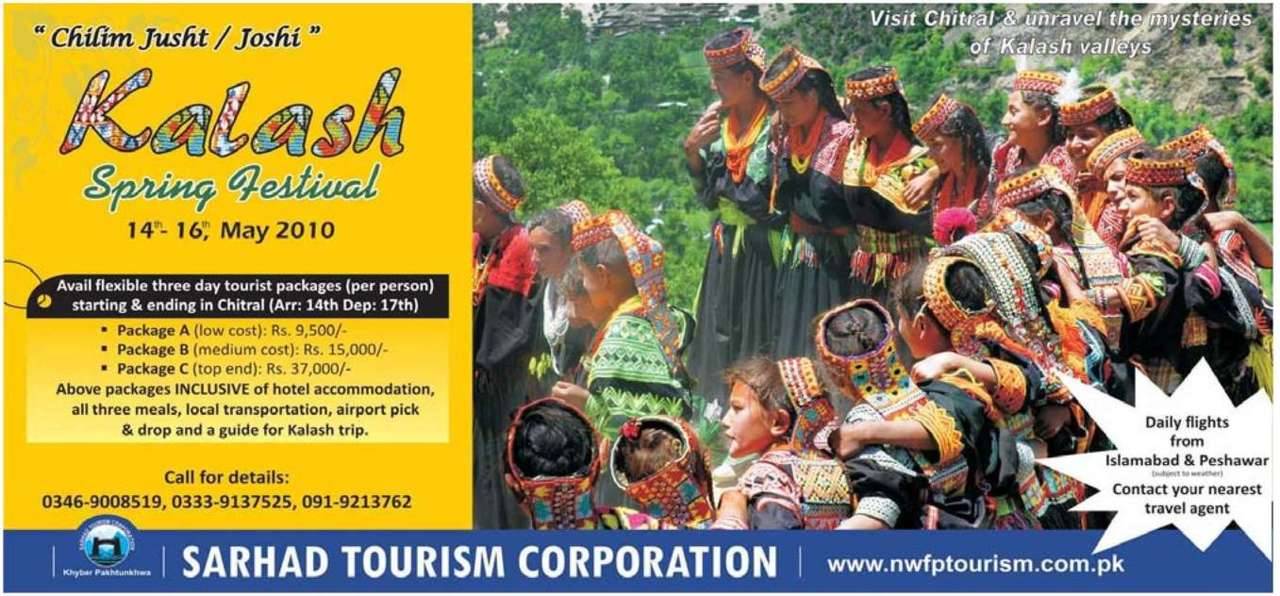
The Kalasha women wear a traditional outfit and neck beads as a hallmark of their Kalasha religion and they don’t cover their faces. PHOTO: SIKANDAR
Did you know that there is a pre-historic animist religion called Kalasha –  a religion still practised and cherished by the Kalasha people of the Hindu Kush valley?
Are you also aware that the Kalasha people don’t even have an option to choose their religion in the ‘religion box’ endorsed by the National Database and Registration Authority (NADRA)?
Nadra came under scrutiny when it refused to rectify typographical errors it had made of a Christian MPA Rana Mahmood that identified him as a Muslim on his national identity card.
The issue drew a considerable amount of attention from both the media and human rights activists, who criticised Nadra for various violations of fundamental rights. Following the criticism, Nadra issued an official statement apologising for the error made. The statement reads:
[A] High level inquiry was ordered by the authority to investigate the matter as to why such inconvenience was caused to our honourable MPA… [I]t was revealed that a Nadra data entry operator had mistakenly put his religion down as Islam because of his Muslim-sounding name.
The Kalasha community has been a victim of this human rights contravention by Nadra since the day the ‘religion box’ was introduced by General Ziaul Haq in the 1980s and the ‘Kalasha religion’ was not included in the list of religions.
An old Kalasha elder confides that,
We didn’t have any option to have our religion on our identity cards like everyone else, even though our religion is the oldest of all, so we brought the matter to the attention of MP Bhandara (MNA elect for minorities), when he visited the Kalasha Valleys. He made an effort to convince the authorities to include the Kalasha religion in the list of religions but they didn’t register Kalasha instead they included ‘others’ in the list of religion as an option.
When the computerised national identity cards (CNIC) were introduced, the Kalasha religion appeared in the list of religions for a short while before Nadra removed it again. (One is led to ask who exactly instigated this removal and why?)
The Kalasha tribe has repeatedly protested, demanding recognition for their religion – an acknowledgement which is their constitutional right to have but the authorities have shown no interest, constantly ignoring their plea to the point of even sidelining a recommendation from the Ministry of Minorities Affairs to include the Kalasha religion in the list of religions.
The outcome of this ignorance and negligence, due omission, is that it paves a way for systematic discrimination.
For example, in Chitral, Nadra officials have repeatedly insisted that the Kalasha women cover their dresses with a scarf while taking photos for their national ID cards. The Kalasha women wear a traditional outfit and neck beads as a hallmark of their Kalasha religion and they don’t cover their faces.
On the one hand, the Kalasha people are deprived of their rights to maintain their identity, culture, religion and language as per the constitution, while on the other hand the tourism ministry exploits them, making every effort to feature the Kalasha women in posters and commercial marketing, using them as advertising assets as the ‘Mystery of the Kalash’ on their brochures and billboards.
And yet they have no right to be acknowledged or accepted as a separate religion.
With all this flamboyant advertising, where is the sense in asking them to cover their traditional neck beads with a scarf in the ID card profile photo?
Can Nadra’s motives be questioned in this case?
Does it mean that Nadra is on a mission to assimilate every diverse cultural aspect of the people of Pakistan?
Nadra seems to have claimed the right to decide people’s faith, depriving Pakistani citizens from acknowledging their respective faiths; tarnishing their rich cultural and religious heritage. In fact, the whole idea of declaring religion in official documents is absurd, since religion is regarded as a personal matter.
Having to declare religion for official use should be treated as a violation of our basic primary rights.  It may lead to discrimination in official as well as daily affairs.
If, however, declaration of your religious belief is still a prerequisite, then it is high time Nadra revises its discriminatory policy towards other religions and either amends the list it has at the moment to does away with it altogether.
They have to accept the fact that Kalasha is a separate religion, and they have to concede to the religious diversity in Pakistan so that every Pakistani, whether Muslim or non-Muslim can be confident that they are equal before the law regardless of their religious or spiritual beliefs.
The mistreatment of the Kalasha people in Pakistan has been very well observed, noticed and pointed out by Ms Nosheen Abbas, a BBC journalist, who calls to attention a very important fact about the complex situation they face. She says,
Pakistanis would view Kalash culture with disapproval but nevertheless many, mostly men, still flock to the valleys from around the country to experience the liberation the festival offers.
The Kalash use the blanket term “Punjabi” for the Pakistani men who suddenly show up in the village staring at women, trying to “chat them up”, and making many feel uncomfortable. They do not consider themselves Pakistani. In fact, they call anybody from elsewhere in the country “Pakistani” – as if that term would not cover themselves as well.
The Kalasha tribe, like every other minority group, deserves what the constitution provides for them; the basic right of recognition and acknowledgement.


Thursday, March 22, 2012

Kalash Culture to Figure as UNESCO Heritage

Kalash Culture to Figure as UNESCO Heritage

ISLAMABAD: In order to preserve endangered living culture of Kalash Valley, the government documented it for inscription in World Heritage List of Unesco.
A one-day workshop was organised on Wednesday at Lok Virsa on preparation of the nomination dossier for inscription.
In his opening remarks as chief guest, Federal Secretary for National Heritage and Integration Faridullah Khan informed the participants that his ministry had come up with a plan to safeguard the endangered heritage property.
In this connection, it has been decided to immediately launch preparation of the nomination dossier, he said.
“This necessitates full involvement of all stakeholders including local governments, NGOs/INGOs, provincial and federal governments,” he maintained.
The discussions revolved around certain measures to be taken to safeguard Kalash cultural heritage including devising an inventory of endangered elements of tangible and intangible culture; efforts for documentation and preservation of Kalash culture in model Kalash villages of Bamborate, Birir and Rambur; safeguarding Kalash language from outside elements; protecting Kalash religion; seeking ways and means to preserve the music of Kalash in its original form; and protecting Kalash nomenclature.
Talking to media, Lok Virsa’s Executive Director Khalid Javaid said Lok Virsa had established a creative diorama at the National Heritage Museum to depict living culture of the Kalash people.
Lok Virsa has also published a book on Kalash which can facilitate students and researchers to undertake further cultural studies on this neglected area, he added.
The present Kalash community is restricted to three parallel valleys of Chitral district i.e. Bomboret, Birir and Rambur.
In Birir and Rambur, Kalash people outnumber the non-Kalash while in the more picturesque Bamboret valley the non-Kalash people are in a slight majority.
These three narrow V-shaped valleys are situated in the South-West of Chitral town, Khyber-Pakhtunkhwa.
In 2007, the local government department created a separate union council of Bamboret for the Kalash valleys.
The word Kalash bears three meanings: Kalash is a name of the tribe; name of pagan religion and name of endangered language.
According to historical references Kalash were majority population in Chitral who ruled the area in 12th century. The recent history shows that Kalash population is on the decline.
In 1951 Census, the Kalash population was 10,000. During the last 60 years, the population of the Muslims in Chitral is increasing at the rate of 2.5 per cent per annum and the population of Kalash has decreased from 10,000 to 3,700.

Source: http://www.dawn.com/2012/03/01/kalash-culture-to-figure-as-unesco-heritage.html